

What does it take to make complex technology genuinely simple to use? And what happens when a customer challenges the way you’ve always done things?
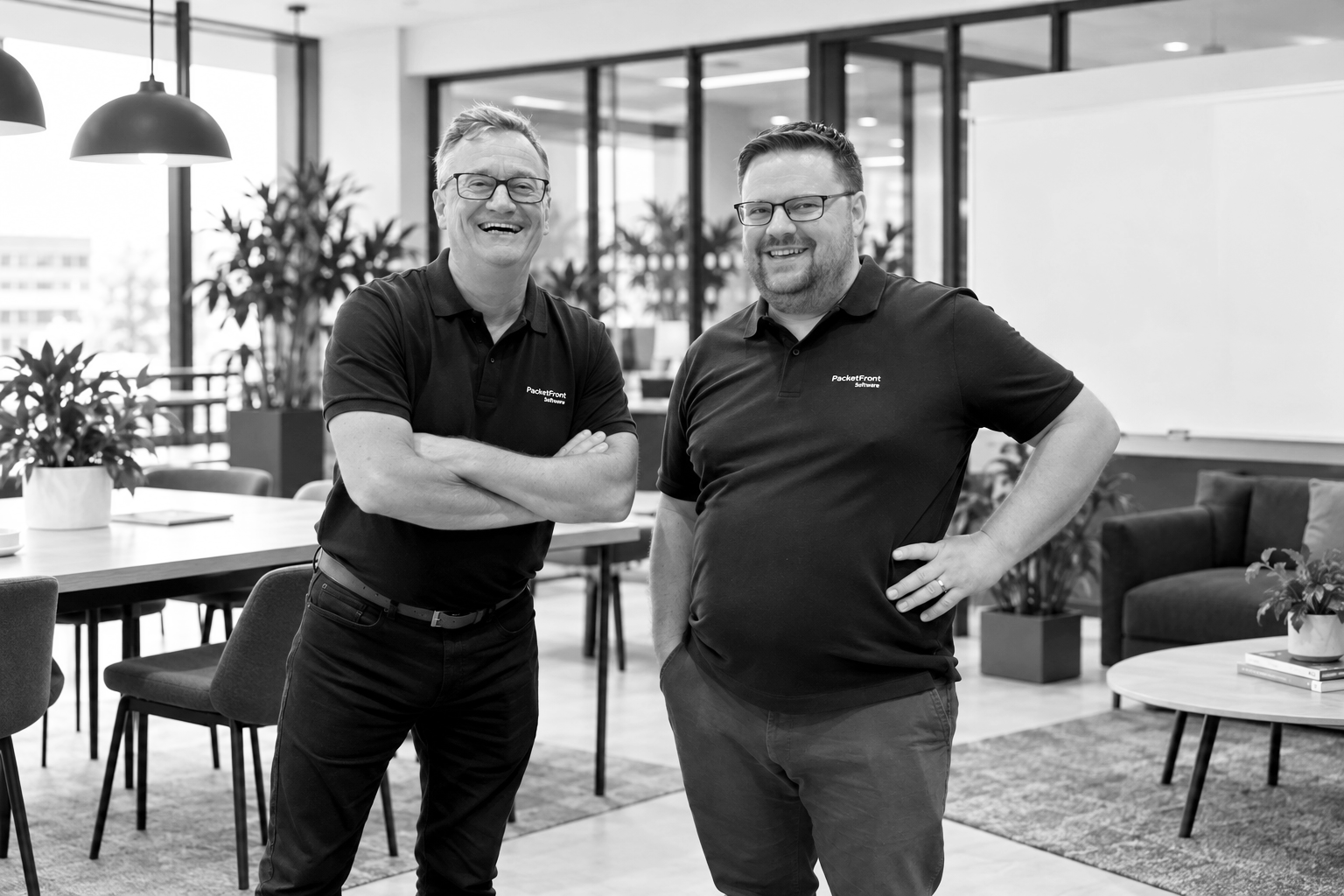
For Lloyd Warn, Account Director, and Tony Green, Senior Sales Engineer at PacketFront Software, developing BECS Focus, an award-winning solution, together with Southern Communications Group (SCG) raised both questions.
What began as an opportunity to bring advanced network orchestration to a wider enterprise market became a learning experience that challenged familiar ways of working, from product development and documentation to the relationship between customer and supplier. Not because the technology couldn’t do what was needed, but because making it easy for others to use turned out to be a challenge of its own.
We caught up with Lloyd and Tony to talk about how it started, what proved more difficult than expected and what they’ve taken away from the experience.
It started with a different customer need
– So, take us back to the beginning. How did BECS Focus come about?
Lloyd: It really started with conversations we were having with SCG. They wanted to give their enterprise customers more control over their networks, but without introducing another layer of complexity.
We already had BECS, which could do most of what they needed. But SCG was looking for something they could offer to a much wider customer base. It needed to be straightforward to deploy, easy to support and something customers could use without having to become network specialists.
Tony: And that was the interesting part. We weren’t starting from scratch, far from it. We already had a very capable platform. The challenge was working out how much of that capability the customer actually needed to interact with. Just because BECS can do something doesn’t mean everyone using it needs to see how it works.
– Moderator: So it wasn’t really about building more functionality?
Tony: Not primarily, no. It was about looking at what we already had from a different perspective. We needed to change our thinking from what the technology was capable of doing to what the customer actually needed to do.
Simple is harder than it sounds
– When did you realise this might be more challenging than you’d first thought?
Tony: Quite early, actually. And the difficult part wasn’t necessarily the technology. It was how we thought about it.
When you’re used to working with a platform like BECS, you know your way around it. You understand the processes, you know what happens behind the scenes and certain things just seem obvious. But they’re not obvious to someone who’s never used it before.
SCG kept bringing us back to that. Their customers shouldn’t need to understand everything happening underneath. They just need to be able to do what they came to do.
 Lloyd: And from SCG’s point of view, that was essential. They weren’t looking for a solution that required a team of specialists every time they brought on a new customer. They wanted something they could deploy and support consistently. So we had to think beyond the technology itself and look at the whole experience.
I think that was one of the biggest shifts. We had to stop assuming that because something was technically straightforward, it would also be straightforward for the customer.
Then came the reality check
– It’s easy to talk about simplicity. How did you actually put it to the test?
Tony: One of the most useful things we did was ask SCG engineers to deploy Focus using our documentation. One of them had never worked with BECS before, and that turned out to be quite revealing.
The people who had developed the documentation, on both sides, knew BECS extremely well. I’d actually raised concerns about that early on, because when you’re familiar with a system, it’s easy to assume things are obvious when they’re not. But everyone had already put so much work into the documentation that there was some resistance to changing it.
Then the first person without any BECS experience tried to follow it, and it became clear that we needed to rethink our approach.
And of course, you can’t just point out a problem and walk away! So I rolled up my sleeves and created a new documentation template that guided users through everything step by step. We tested it with the users, they confirmed it worked, and then we rewrote the documentation using that approach.
Looking back, it’s a good example of the sunk cost fallacy. We’d already invested so much time and effort that changing direction wasn’t an easy decision. But sometimes the best thing you can do is stop, rethink and start again.
Lloyd: And that’s where the commercial side and the technical side really came together. You can have a product that works perfectly well, but if every deployment takes too much time or requires specialist knowledge, it’s going to be difficult to scale.
SCG needed to be confident that Focus could become part of its everyday business, not something that required a special project every time.
Challenging familiar ways of working
– Was there anything that proved particularly frustrating along the way?
 Tony: I think one of the biggest challenges was actually changing the way we approached the relationship with SCG.
We’re used to working closely with customers and making sure they get exactly what they need. That’s always been important to us. But this was different. We weren’t simply delivering something SCG had asked for. We were developing a product together, and that meant we had to take ownership of the decisions rather than automatically treating every piece of customer feedback as something we needed to implement.
It’s an interesting shift, moving from a traditional customer relationship to a genuine partnership. And we occasionally caught ourselves slipping back into our usual way of thinking.
Lloyd: I think we also had to challenge the idea that simplifying something means making it less capable. It doesn’t. The technology underneath can still be just as sophisticated. The difference is that the customer doesn’t have to deal with all that sophistication.
There were frustrations, of course, but I think they were useful ones. They forced us to focus on what SCG and its customers actually needed, rather than what we were used to delivering.
Tony: That’s probably one of the biggest things I took away from it. The complexity should be handled by the technology, not passed on to the person using it.
Two perspectives, one objective
– You came into this from quite different backgrounds. Did that make a difference?
Lloyd: Definitely. My background is in enterprise technology and channel partnerships, having worked at Oracle, Sun Microsystems and Ingram Micro. So I naturally look at things from the customer and commercial perspective.
For SCG, it wasn’t enough to have great technology. They needed something their teams could explain, sell, deploy and support without unnecessary complexity. And Matt Wring, CTO at SCG, and his team were very clear about that throughout the project.
Tony: My background is a bit different. Before PacketFront, I worked at Broadway, an alternative network provider, so I’ve been on the operational side myself. I know how important it is that things work reliably and efficiently when you’re actually running a network.
But working on Focus also challenged some of my own assumptions as an engineer. We’re naturally interested in what technology can do. Sometimes we need reminding that the person using it may have a much simpler objective.
Lloyd: And I think that’s where working closely with SCG made such a difference. We had the technical perspective, the commercial perspective and the experience of the people who would actually be delivering the service.
We didn’t always approach things from the same angle, but we were working towards the same outcome.
What stays with you afterwards?
 – Looking back, has the experience changed the way you approach other projects?
Tony: I think I’m more conscious of questioning complexity now. Rather than just asking whether we can make something work, I try to think about whether we can make it easy for someone else to operate. It’s a fairly simple question, but it can change how you approach a problem.
Lloyd: For me, it’s reinforced how important it is to understand the customer’s situation properly before deciding what the solution should look like. It’s easy to focus on the capabilities you can offer. But what matters to the customer is whether those capabilities actually make their working life easier.
And I think the experience has shown how much stronger the result can be when the commercial and technical sides work closely together, with the customer involved throughout.
And where does it go from here?
– Do you see the lessons from SCG having a wider impact?
Lloyd: Yes, because the challenges SCG was trying to address aren’t unique.
There are plenty of managed service providers and enterprises that want better visibility, more control and greater automation, but don’t necessarily want the complexity that can come with it.
What we’ve learned through this project gives us a stronger foundation for making those capabilities accessible to more customers.
We’re still working towards the broader commercial ambitions for Focus, but we’ve learned a great deal along the way.
Tony: And technically, the work we’ve done on simplifying deployment and making things more consistent is something we can build on. The goal is to make it easier for different customers to benefit from the same underlying capabilities, without having to understand everything that happens behind the scenes.
Lloyd: I think that sums it up quite well. The technology can be complex. The customer’s experience shouldn’t have to be.
From collaboration to recognition
 The collaboration between PacketFront and SCG has not only helped shape BECS Focus but has also gained industry recognition. In September 2026, BECS Focus won Best Enterprise Managed Service Customer Solution at the Channel National Awards in the UK. Read more about the award>>
 Want to see how BECS Focus is making a difference in practice? Read our customer story, A New Managed Services>>
 Find out all about BECS Focus>>

