
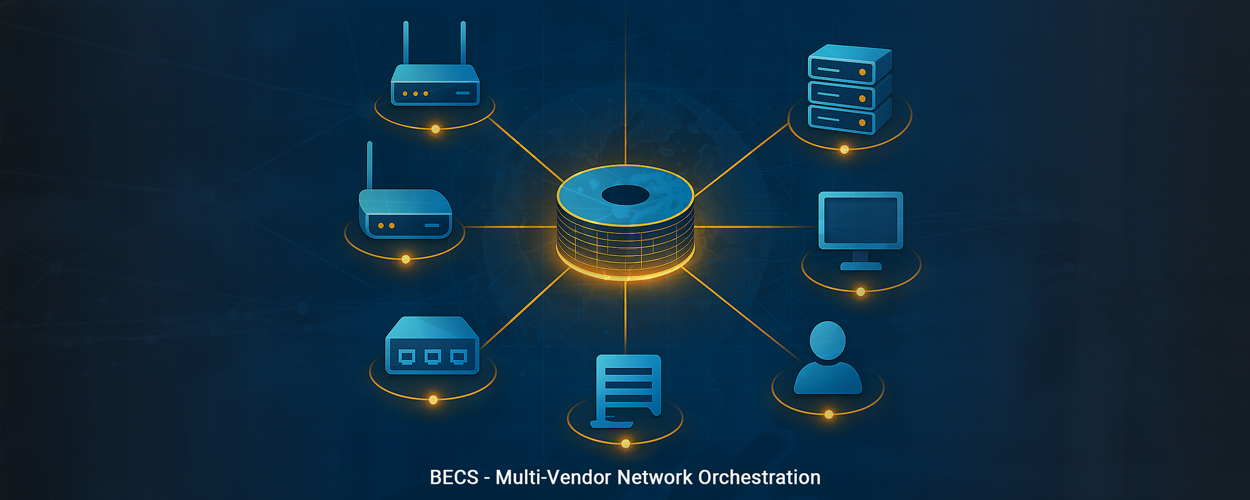
BECS® platform Overview
With over two decades of experience in operational support systems, we have supported AltNets/city carriers, operators and network owners in simplifying network management across multi-vendor infrastructures. From city networks to nation wide deployments, BECS enables structured automation, consistent governance and long-term scalability without locking you into restrictive ecosystems.
Do you want full control and freedom to grow without costly restructurings or operational bottlenecks?
Let us walk you through how BECS supports scalable orchestration built on best practice, flexibility and real operational needs.
Network Orchestration
Network Orchestration in complex network environments
As your network grows, different systems and separated processes can quickly create unnecessary friction. Instead of configuring each network element separately, network orchestration standardises workflows, automates processes and ensures consistent governance across the entire infrastructure, bringing structure to that complexity.
BECS gives you control and vendor neutral network management
BECS Network Orchestration platform brings you even closer to full operational control. As hardware vendors, services and operational demands increase, complexity can lead to disruption and rising costs.
With the BECS platform, vendor specific commands are translated into one consistent operational language. And through this unified control layer, you orchestrate automation, configuration and firmware management across multi-vendor environments with clarity and control.
Instead of reacting to complexity, you operate within a clear framework that supports scalable growth, consistent management and long-term flexibility without being locked into restrictive vendor ecosystems.
This is more than orchestration. It is vendor neutral, multi-vendor network control designed to give you clarity and confidence as your network evolves.
VPN Service Orchestration
With BECS you orchestrate the activation, modification and deactivation of VPN services in real time across Customer Edge, aggregation and Provider Edge layers. All required network devices are configured automatically, ensuring consistent end to end service delivery regardless of underlying hardware.
New VPN services are created and made available to your operational and business systems through structured interfaces. Whether you launch a new service or adjust an existing one, changes can be executed within minutes directly from your CRM environment. Even large scale updates affecting multiple customers remain controlled and predictable.
Intelligent Network Coordination
BECS maintains a complete and continuously updated view of your network topology, including devices, connections and allocated resources such as IP address pools, VLAN pools and routing details. Because the platform understands how these components relate to one another, it determines precisely what must be configured and where.
From the Provider Edge layer through aggregation and access down to Customer Edge devices, with Route Reflectors supporting the control plane, orchestration is executed as one coordinated process rather than a series of isolated actions.
You retain full operational control without having to manage each device individually.
BECS also maintains automated documentation of VPN services, allocated resources and network components, updated in real time. This reduces the risk of over or under invoicing, IP address conflicts, VLAN inconsistencies and unused but configured resources.
%nbsp;
Network Automation
As your network grows in size and diversity, operational complexity follows. Frequent upgrades and expanding service demands can quickly make manual management difficult to sustain. Network automation helps you stay in control by standardising configuration, simplifying firmware management and supporting faster service activation throughout the network lifecycle.
By reducing manual intervention and bringing processes together, network automation lowers operational costs, improves reliability and supports steady, long-term network growth.
How BECS supports Network Automation
Making network automation work in practice requires more than scripts or isolated tools. It requires a platform designed to bring structure and coordination across the entire environment.
The BECS platform is built on a scalable architecture that supports automation across complex network environments. As your infrastructure expands and new devices are introduced, management becomes more demanding. BECS applies structured and repeatable workflows to automate configuration, service activation and firmware management, ensuring consistency and operational control as your network evolves.
Instead of managing each vendor or system separately, you work within a unified control framework. This helps reduce operational workload, strengthens clarity across teams and gives you the confidence to grow without losing control.
Real-time Configuration changes
BECS ensures that network devices always reflect the correct configuration when services are added, modified or removed. Outdated or unused configurations are automatically identified and corrected, reducing the risk of inconsistencies across the network.
Software Management
BECS helps you maintain the intended software versions across your network. You can define software policies for different parts of the infrastructure, ensuring that devices run approved and consistent firmware versions as your network evolves.
Zero-Touch Deployment
When supported by the hardware, new network devices can be introduced without manual pre-configuration. BECS automatically applies the appropriate configuration and software version, bringing devices into operational alignment with your defined policies.
Operational Control in Daily Operations
BECS provides real-time operational control across your network, from the core to customer-facing equipment.
Through structured automation, you can:
- Configure services end to end
- Manage large fleets of network devices
- Maintain continuous visibility of network resources
- Keep operational documentation automatically updated
Large scale updates affecting thousands of devices can be executed within minutes, with accuracy and consistency.
The result is a more reliable and scalable operational model, with reduced manual intervention and fewer configuration risks as your network grows.
Multi-vendor network hardware integration
BECS Atlas - The full-scope platform for orchestration, automation, configuration and service control
Our Multi vendor Network Hardware Integration capability enables you to manage and orchestrate hardware from a wide range of vendors through a unified control layer.
Through an integration layer developed by PacketFront, vendor specific commands are translated into one consistent operational language. This allows you to manage diverse hardware environments from a single interface, without being restricted to formal vendor partnerships.
You gain flexibility, vendor neutrality and full orchestration control. The integration is designed around your operational needs, ensuring flexibility, long term scalability and freedom to choose the hardware that best fits your network strategy.
A single integration point between your systems and network
BECS Atlas acts as a single integration point between your systems and your network. By abstracting the complexity of the underlying hardware, automation increases while integration effort is reduced.
Instead of building and maintaining multiple integration paths, you work through one structured layer.
One service model across your entire network
BECS Atlas simplifies integration by creating a single service definition per service type across your entire network, regardless of vendor or technology.
When you introduce a new hardware vendor, your OSS layer does not need to change. Your service catalogue remains consistent, while the complexity is handled underneath.
That gives you freedom to evolve your network without constant system restructuring.
Open and documented API for seamless integration
BECS Atlas is built on an open and well documented API, ensuring smooth integration with your existing OSS systems and external platforms.
The network is abstracted northbound through a service catalogue, so adding new services or vendors does not require structural changes in your business systems.
You can connect other systems easily through open APIs, while keeping your operational structure intact.
Vendor modelling and protocol flexibility
The BECS platform Element Management framework allows it to communicate with any vendor using the required protocol, including CLI, SNMP, TR-069 or NETCONF.
Each element is modelled so that the platform understands its native language. This enables structured automation without relying on formal vendor partnerships.
Support for major vendors is included, and new hardware can be modelled efficiently using built in tools.
Operational Intelligence Engine
The intelligence layer behind your Network Automation
What makes BECS Atlas different is not only what it automates, but how it understands your network. BECS Atlas structures and connects network elements, topology, resources and configuration into one coherent operational model. Instead of treating devices and services as isolated components, BECS Atlas understands how everything relates. That is what enables true end-to-end automation, across network deployment, service activation and ongoing resource management.
When you update a configuration, whether it concerns a specific element, a role, a geographical area or a service type, BECS Atlas determines exactly what needs to change. It works by comparing the desired state of your network with its actual state, ensuring that only the necessary changes are applied. The platform then moves from state “A” to “B” automatically, applying only what is required, where it is required.
Four Dimensions Working Together
- A network is defined by details.
- Which IP address is used where?
- Which element connects to which?
- What role does it have?
- What characteristics does a provisioned service include?
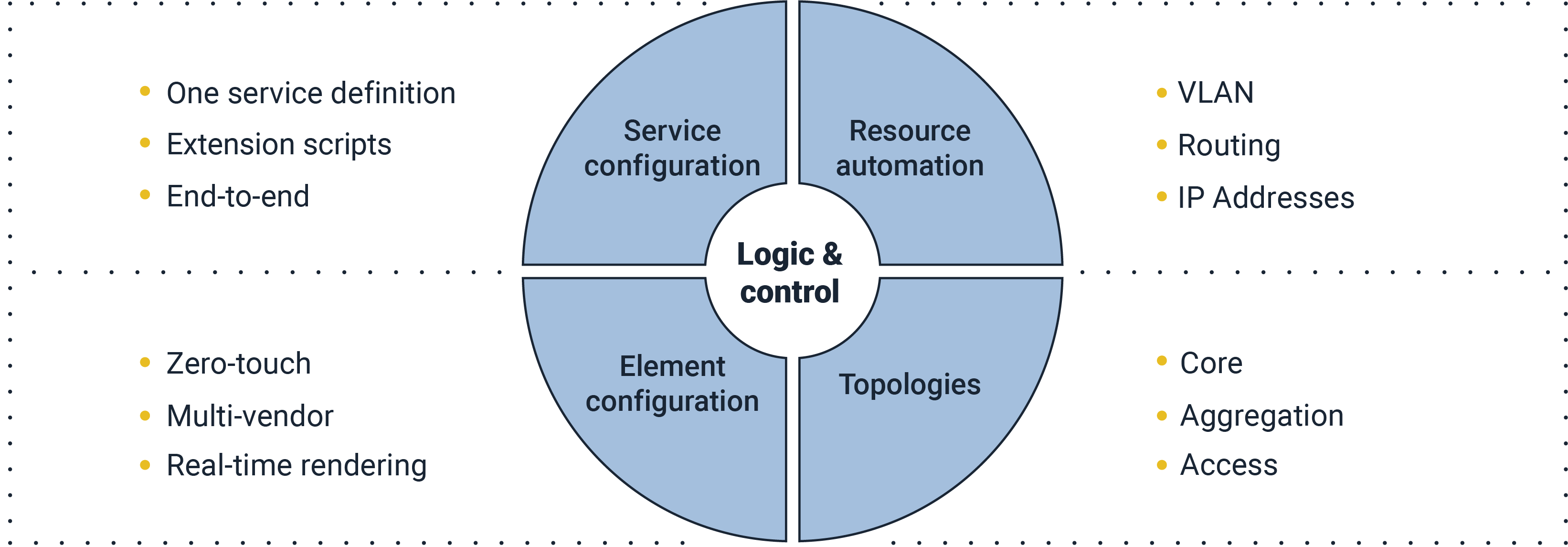
BECS Atlas brings these four dimensions together:
- Resource Management
- Service Configuration
- Topology
- Device Configuration
By understanding how they relate, BECS Atlas turns complexity into structured automation.
Policy Enforcement Built In
Automation without governance creates risk. With BECS Atlas, operational rules are defined as network policy and enforced automatically.
When BECS Atlas connects to network elements it applies configuration according to your defined policies and highlights topology inconsistencies before they become operational problems.
You maintain control and the system ensures consistency.
Scalability & Architecture
BECS Atlas is designed to support networks of any size, from hundreds to millions of ports.
BECS Atlas Core-Cell architecture enables distributed deployment and structured load balancing. The core operates as the central intelligence, while one or several cells handle execution across geographically distributed environments.
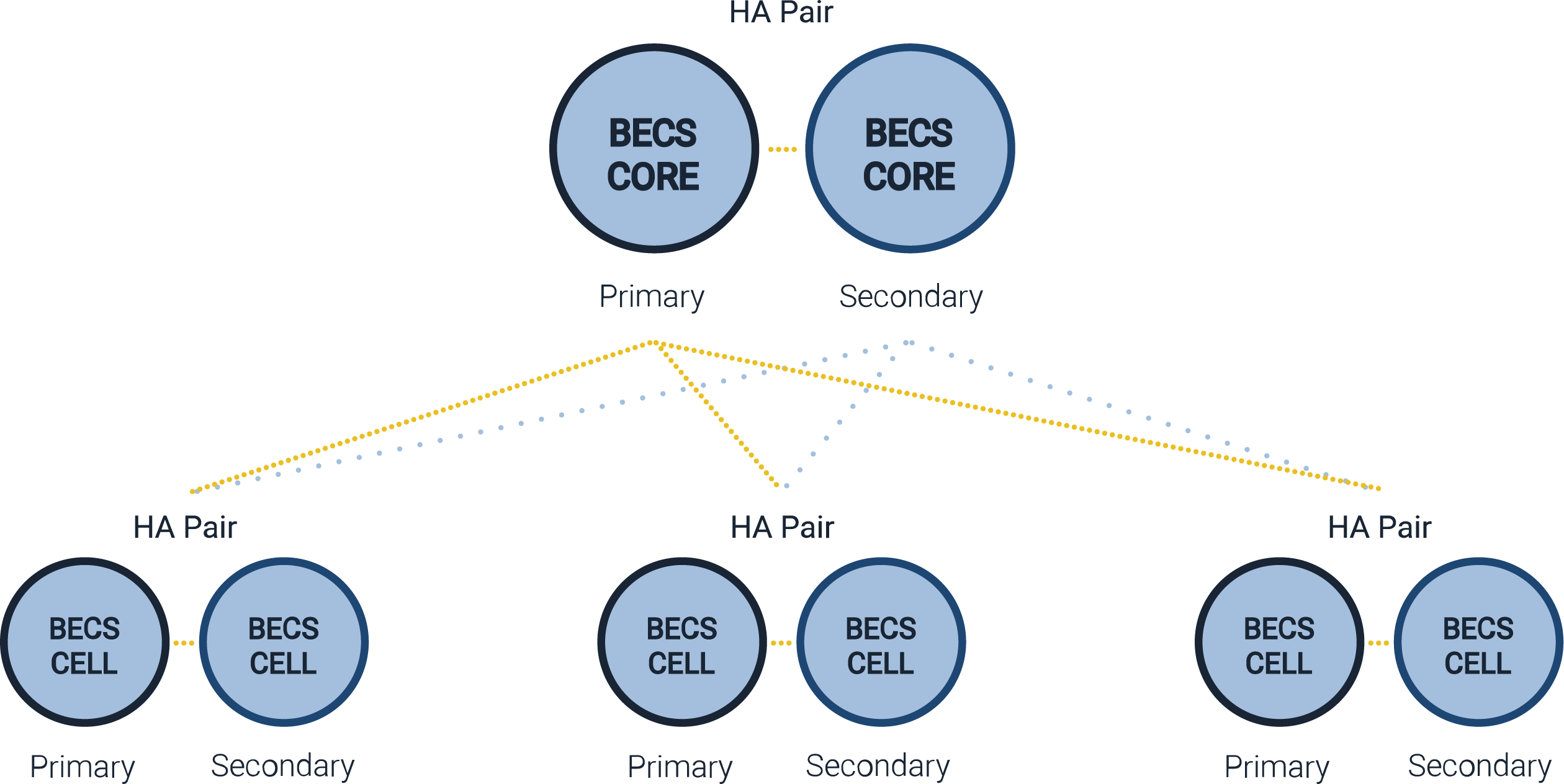
This modular design allows your network to grow without compromising stability or performance.
The Core-Cell structure can be configured in High Availability mode, ensuring continued service delivery even in the unlikely event of hardware or software failure.
Together, the architecture and modular design meet the demands of carrier-grade operations, giving you the confidence to scale as your network evolves.
Mergers & Acquisitions
Seamless Network Growth through Mergers & Acquisitions
When your business grows through partnerships or acquisitions, your network should support that growth rather than complicate it.
BECS Atlas enables you to integrate new environments into your existing operational structure without costly restructuring or disruption.
You remain free to choose the hardware that fits your strategy and budget, while the automation and integration logic remain consistent across your network. As new infrastructure is incorporated, governance, service definitions and operational control stay intact, allowing you to scale with confidence and maintain a strong negotiation position.
What this means for you
- Full visibility and operational control across combined network environments
- Reduced integration complexity during consolidation
- Lower operational costs over time
- Less manual intervention and fewer configuration risks
- Greater flexibility in vendor negotiations
- More time to focus on strategic development and customer value
Integrations & Partnerships
Through multi-vendor hardware integration and complementary software integrations, the BECS platform connects diverse technologies within a structured and unified operational framework. The result is flexibility, vendor neutrality and scalable network control as your infrastructure evolves.
BECS® Editions
Not every network starts in the same place, and not every organisation has the same needs. BECS is available in two Editions: BECS Atlas and BECS Focus. Built on the same proven BECS foundation, they provide different ways to use network orchestration and automation depending on your business, your network environment and how you deliver and manage services.
BECS Atlas provides the full scope of BECS, while BECS Focus extends the value of BECS into enterprise environments through a streamlined managed services model.
Together, they provide a flexible foundation for network automation and service delivery, allowing you to build around what you need today and develop as your business and customer needs evolve.
Start where you are. Grow when you are ready.

BECS® Focus
With BECS Focus, you provide automated and structured network operations as a managed service. You stay in control, manage the environment, and your customers benefit from it.
It carries the strong orchestration and automation capabilities you expect from BECS, but in a more optimised and practical setup. The stability and reliability are still there, but the daily operations simply become easier to handle.
Your customers experience services that feel smooth and straightforward, while you strengthen relationships and grow together. Powerful on your side, clear and simple on theirs.
With BECS Focus we empower you as an operator to deliver smarter network management to the businesses/enterprises you support, with value for both you and your customers.
One solution for you and the businesses you support
BECS Focus is a streamlined edition of the BECS Atlas, created for operators and service providers who want to offer managed network services to their enterprise customers.
It provides a clear and simple way to work together. You manage and automate the customer’s network, while your enterprise customer gets an easy-to-use interface to manage their everyday services.
As the operator, you remain in control of network configuration, automation, policies and device lifecycle management. Your customer can take care of the day-to-day tasks relevant to their business, without needing specialist networking expertise.

Behind BECS Focus is BECS Atlas, our full-functionality edition of the BECS platform, giving you the network orchestration and automation needed to manage both single- and multi-vendor environments for your customers.
With BECS Focus, the vendor-neutral capability extends beyond your own network and into the enterprise environments you support, with you managing the complexity and your customers managing what they need.
What this means for you
- Stronger customer relationships: Deliver reliable network services that help build trust and long-term customer relationships.
- More value, without added complexity: Extend automation and professional network management to your customers while keeping things simple for your own team.
- A smoother start: Ready-made models and migration guides help bring your customers’ existing networks under automated management.
- Faster service rollouts: Introduce new services more efficiently, helping keep projects moving and customers satisfied.
- Cost-efficient growth: Expand your services without the need for heavy investments or additional specialist resources.
- Success that goes both ways: Help your customers operate more efficiently while creating opportunities to grow together.
What this means for your customers
The confidence of enterprise-level network management, without the cost or complexity
With professionals managing the more complex parts of the network infrastructure, your enterprise customers can make better use of their valuable IT resources without needing to build specialist networking expertise in house.
Combining the service provider’s expertise with automation helps reduce errors, speed up operations and provide the reliability needed as the business grows.
A more flexible way to manage the network
Rather than choosing between complete outsourcing or complete internal ownership, your enterprise customers retain visibility and control of day-to-day operations, such as mapping services, through an easy-to-use interface designed for non-experts. At the same time, they can rely on their managed service provider for specialist expertise, lifecycle management and the more complex parts of network operations.
This means lower costs, faster rollouts and a reliable network, while allowing their IT teams to focus their time and resources where they are needed most.
In their everyday operations:
- Less manual work: Routine network tasks are handled automatically, saving time and helping reduce errors.
- Faster changes: New sites, services and updates can be introduced quickly and smoothly.
- Greater visibility: Customers retain insight into their network while their service provider takes care of the day-to-day management.
- More predictable costs: Advanced network management without the need for significant investments in additional tools or specialist resources.
- A network they can rely on: Consistent, secure and well-managed operations that support the business as it evolves.
How BECS Focus Works
Extending network orchestration to the enterprise edge
BECS Focus creates a clear separation between operator-controlled network automation and customer-controlled service management. Operators retain ownership of network policies, workflows, device onboarding, and automation logic, while enterprise customers gain a simple, intuitive interface for day-to-day service operations, i.e. service turn up, turn down etc. without having the power to make potentially destructive changes such as removing vital base configuration. This enables both parties to work efficiently without compromising governance, security, or operational consistency.
Operators handle configuration logic, automation, and device lifecycle management while customers use a simplified interface for everyday tasks. Because BECS Atlas is truly multi-vendor, the edition BECS Focus presents network devices in the same consistent and standardised way for all hardware vendors which greatly reduces the learning curve usually required to provision services in a multi-vendor environment.
A typical workflow
1. Onboarding tools
BECS Atlas provides tools and wizards to assist in the onboarding and importing of customer network devices for many topology scenarios for the Operator (MSP).
2. Build the base configuration
The base configuration for the network devices is created in BECS Atlas, this is configuration that generally day to day doesn’t change, for example DNS servers, and device hostnames etc.
3. Service definition creation
The service is then created in BECS Atlas, and this defines what configuration is required to provide some kind of service on a port, for example a VLAN or L2VPN/L3VPN service. BECS Atlas has several built-in service templates to cover most scenarios, but as an MSP you can create custom services to fit your customer’s bespoke requirements if required.
4. Enable customer self-service
Once a service has been created it is your customers who, using BECS Focus, can perform approved actions without deep networking knowledge or any input from you (the MSP). All complex configuration in BECS Atlas is hidden in BECS Focus. Actions available in BECS Focus for end customers include the following:
- Easily view available services
- Activate and deactivate those services using a simple drag and drop interface
- Make changes to existing services immediately
- Manage user access
- Monitor service status
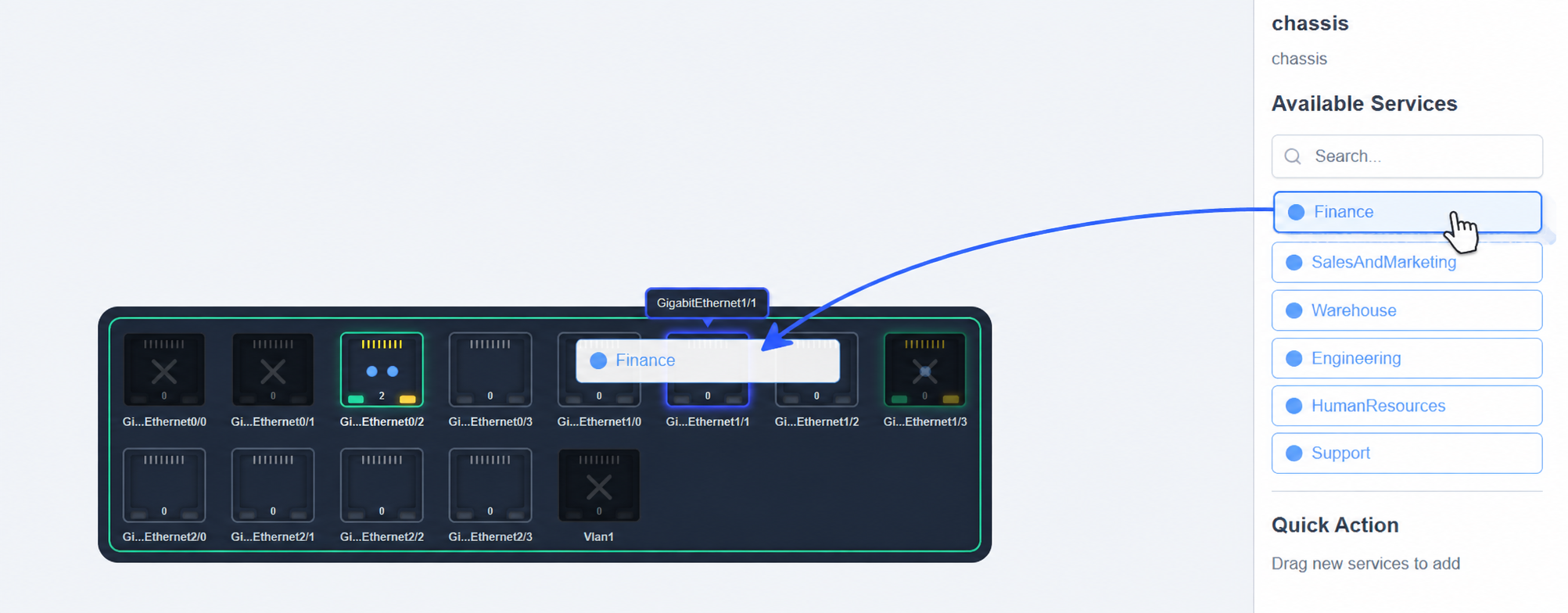
Fig 1 – In the above example the “Finance” VLAN is dragged onto a port, this could be a hot desk where VLAN membership changes often for each ethernet wall port.
5. Maintain continuous control
Every action remains governed by operator-defined policies, providing security, traceability, and compliance while reducing operational risk. All changes made by BECS Focus to network devices are logged with the time those changes were made, and which user made the change. All configuration changes to devices are made via the BECS platform, thus removing the need for engineers to log in to devices manually.
6. Workflow process
If service configuration changes are required, or a new service is required for the customer, You (The MSP) can make these changes in BECS Atlas as you have the full power and capability that BECS platform has to offer (steps 1-3). Once complete and the services have been tested the customer can then use these services in BECS Focus (step 4).
BECS® Atlas
It is designed for operators who want complete visibility, deep functionality, and full flexibility across complex multi-vendor networks. If you want everything BECS can offer from day one, Atlas is your foundation.
How BECS Atlas works
Automated workflows in BECS Atlas ensure that all configuration required to make a service function is enacted on every device in the network chain, even in multi-vendor setups.
When a service is no longer required, that service is simply removed and any configuration on devices in the network previously required to make that service function is also removed. Full clean up, no orphaned configuration is left on devices.
Network devices can also be configured using zero-touch provisioning (ZTP). Because BECS Atlas is aware of the topology of the network, when a new device is connected BECS Atlas receives the ZTP request and sends the correct configuration for that device. ZTP is available for both core network equipment and CPE’s.
Modules, packages & add-on capabilities
That is why we have developed modules, packages, and add on capabilities. They give you the flexibility to adapt, extend, and refine the platform in a way that truly fits your business. Whether you are scaling, introducing new services, or responding to changing market demands, you can build on the core without starting from scratch.
This approach allows you to move at your own pace, invest where it matters most, and stay in control while continuously unlocking new value.
BECS® Streamlined Module
Less friction. More clarity.
 We have built this around real operational needs. Around everyday situations. Around the moments where clarity and structure make a real difference.
Created around everyday user experience, it makes managing your network clearer, more intuitive and accessible across the wider team, while preserving its full depth and capability. All delivered through a new interface.
Inventory
A clearer and more structured way to manage device information, including hardware and CPE visibility, installed modules and firmware versions. Inventory provides improved transparency and overview, helping your team act with clarity and confidence.
Firmware management
Upgrade one or many devices from one firmware version to another in a controlled and streamlined way. Reduce manual handling and simplify lifecycle processes.
New operational workflows
Structured and simplified workflows that make previously complex commands easier to execute.
Streamlined automation
Fewer manual steps, more consistency and smoother daily operations.
Improved device lifecycle handling
Better structure and clarity around how devices are managed, updated and maintained.
What changes in practice?
Everyday management becomes clearer and more intuitive. Tasks that previously required deeper system knowledge can now be handled more smoothly, enabling broader team participation and shared responsibility.
Specialists and experienced engineers remain essential. Instead of being pulled into routine operational steps, they gain more time to focus on work where their expertise creates the most value.
The result is:
- Smoother daily operations
- Clearer responsibility distribution
- Stronger collaboration across the team
- Lower operational costs
- More confident handling of BECS Atlas
BECS Streamlined Module strengthens BECS Atlas by introducing a simpler way to manage selected functions and commands through a new interface designed for clarity and efficiency. In short, it helps you operate with greater ease, structure and confidence as your network continues to evolve.
In the March 2026 release, Inventory and Firmware management support Cisco and Juniper hardware and CPEs. Additional vendor support will follow in upcoming releases.